
UX backlog and PR specifications
The top 20 simplification opportunities from the October 2026 audit, items added since (UX-021 onward), then the focused pull requests they group into. IDs are UX-nnn; the product management thread links them from docs/product/PRODUCT_BACKLOG.json.
Priority: P0 blocks core work or is a security risk · P1 significant friction in common work · P2 inconsistency, extra clicks, unclear words · P3 polish.
Owner is the thread that owns the screen. This oversight specifies and reviews; the owner builds, unless the change is in shared UI code no other thread is changing.
Overview#
| ID | Priority | Title | Owner | PR |
|---|---|---|---|---|
| UX-001 | P1 | Command bar prints null between results |
Shared UI (this oversight) | PR-UX-01 |
| UX-002 | P1 | Broken help links, and a test for every help link | Shared UI (this oversight) | PR-UX-01 |
| UX-003 | P1 | Sign-in errors that say what happened | Enterprise readiness (sign-in) | PR-UX-02 |
| UX-004 | P1 | Screens for local data projects; SQL on this PC | Local data engine (FD-LDE) | PR-UX-09 |
| UX-005 | P1 | One first-run card on Home instead of three sign-in prompts | Enterprise readiness (first run) | PR-UX-03 |
| UX-006 | P1 | App (client) ID and engine limits move to Advanced in Settings | Shared UI (this oversight) | PR-UX-03 |
| UX-007 | P1 | Help opens the docs for the running build | Release management (shell) | PR-UX-05 |
| UX-008 | P1 | Back, forward and reopen where you left off | Shared UI (this oversight) | PR-UX-04 |
| UX-009 | P1 | One home for keys, sources, domains, glossary and platform setup | Data mesh, roadmap and Platform threads | PR-UX-07 |
| UX-010 | P1 | Monitor: at most four segments, with Operations grouping the rest | Workload management | PR-UX-07 |
| UX-011 | P1 | One error panel and Retry for every failure | Shared UI (this oversight) | PR-UX-02 |
| UX-012 | P1 | Keyboard access for rows, menus and tabs | Enterprise readiness (accessibility) | PR-UX-06 |
| UX-013 | P1 | Show when the engine is busy, and let people stop it | Codebase audit and hardening | PR-UX-10 |
| UX-014 | P1 | Home and the bell never claim all is well when they couldn't check | Workload management (Home), shared (bell) | PR-UX-10 |
| UX-015 | P2 | Pickers instead of typed IDs and paths | Each feature owner; folder picker shared | PR-UX-08 |
| UX-016 | P2 | One environment picker for the whole app | Shared UI, with Data mesh | PR-UX-07 |
| UX-017 | P2 | Plain words for Fabric internals | Each feature owner | PR-UX-11 |
| UX-018 | P2 | The same confirmation for every destructive action | Shared UI, with owners | PR-UX-12 |
| UX-019 | P2 | Help on every screen; one generated Preview list; keyboard shortcut list | Shared UI and docs | PR-UX-05 |
| UX-020 | P2 | Show Home at once; shared loading and empty states | Shared UI (this oversight) | PR-UX-04 |
| UX-021 | P1 | Preview tag on every action that writes to Fabric without a tenant test | Each feature owner | PR-UX-13 |
Smaller findings kept for later (P2-P3): policy check calls valid integration keys invalid (app_settings.py:143-145); account switcher and tenant choice for guests; placeholder and disabled text at 2.6:1 contrast, signed-out avatar at 3.5:1 (styles.css:103,196); no dark or high-contrast theme; duplicated byte and date formatters (four and six copies); Teams webhook stored in plain text; scheduleNotebook reads state.env, which is never set (app.js:2168); confirmDialog never resolves when closed with Esc (meta.js:411-416); the TOML editor traps Tab (meta.js:324); stale architecture/ai-integration.md.
Issues#
UX-001 Command bar prints null between results (P1)#
- Workflow: W10 Find a feature; every Ctrl+K use.
- Now: a line reading
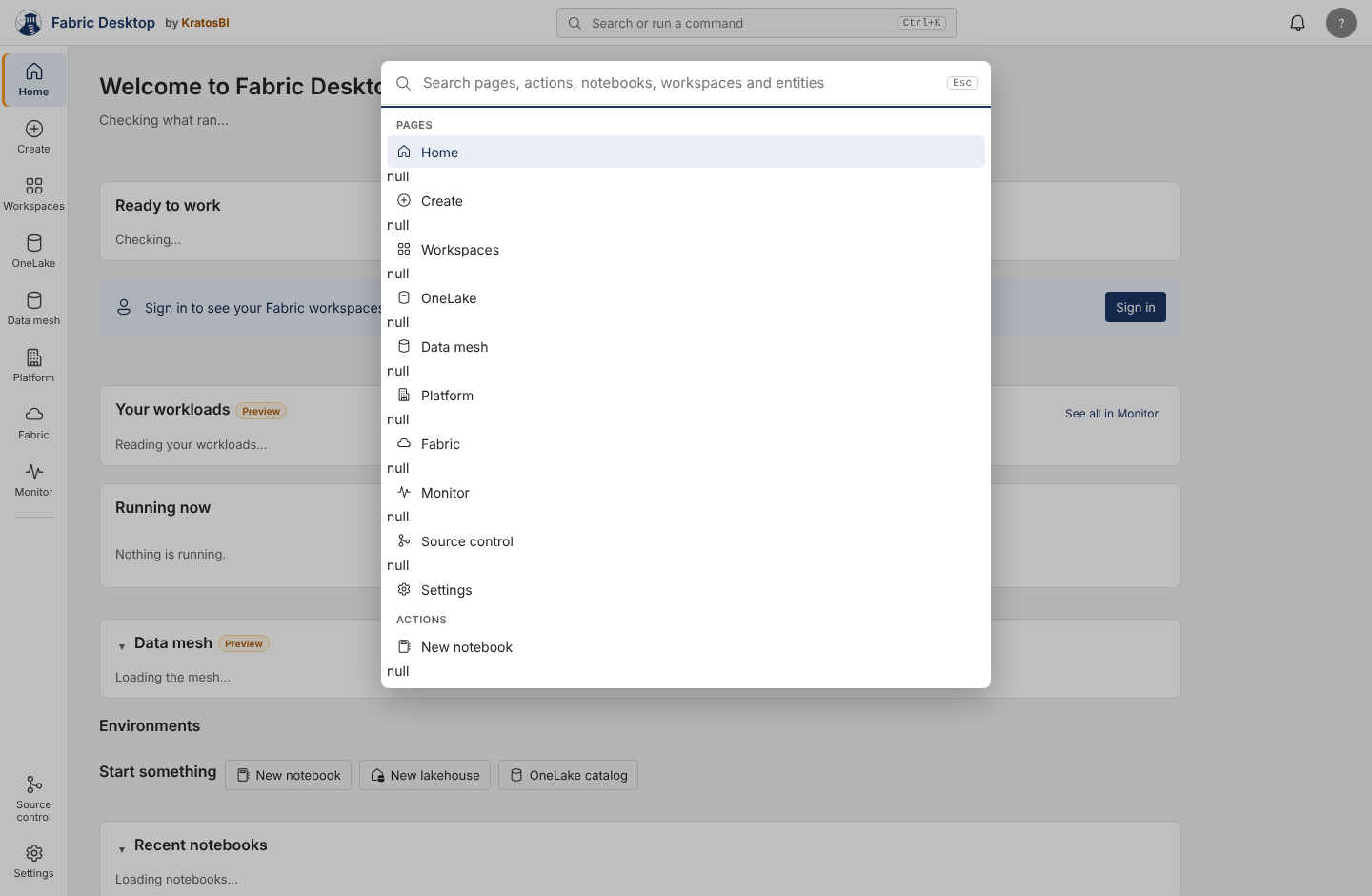
nullappears between every result (images/command-bar-null.png).draw()infeatures.js:129-134returns[head, row]withhead = nullwhen the group doesn't change, andreplaceChildrenturnsnullinto text. - Why it matters: the command bar is how the guidelines say people find everything; it looks broken to every user.
- Proposed: drop
nullentries beforereplaceChildren. - Benefit: the command bar reads cleanly.
- Scope:
features.js, one line, plus a test. - Dependencies: none.
- Acceptance: with no text typed, the list shows group headers and items only; no text node reads
null. - Tests: a
ui.test.cjscase that rendersopenPalette()with fake commands and asserts nonulltext.
UX-002 Broken help links, and a test for every help link (P1)#
- Workflow: all; documentation.
- Now:
learnMore("metadata")(meta.js:114) andlearnMore("source-control")(git.js:112-113) point at anchors that don't exist, so the guide opens at the top. Nothing checks help anchors. - Proposed: fix the two anchors (
data-mesh,source-control-preview, or linksource-control.md); add a test that collects everylearnMore(...),open_docpage,XRAY_DOCSentry and readinessdoc, and checks the page exists and the anchor matches a heading. - Scope:
meta.jsandgit.js(one string each), a new test. - Dependencies: none. Tell the Git and Data mesh owners in the PR.
- Acceptance: the test passes on main after the fix and fails if any anchor is renamed.
- Tests: the new test runs in the existing
uiCI job.
UX-003 Sign-in errors that say what happened (P1)#
- Workflow: W2.
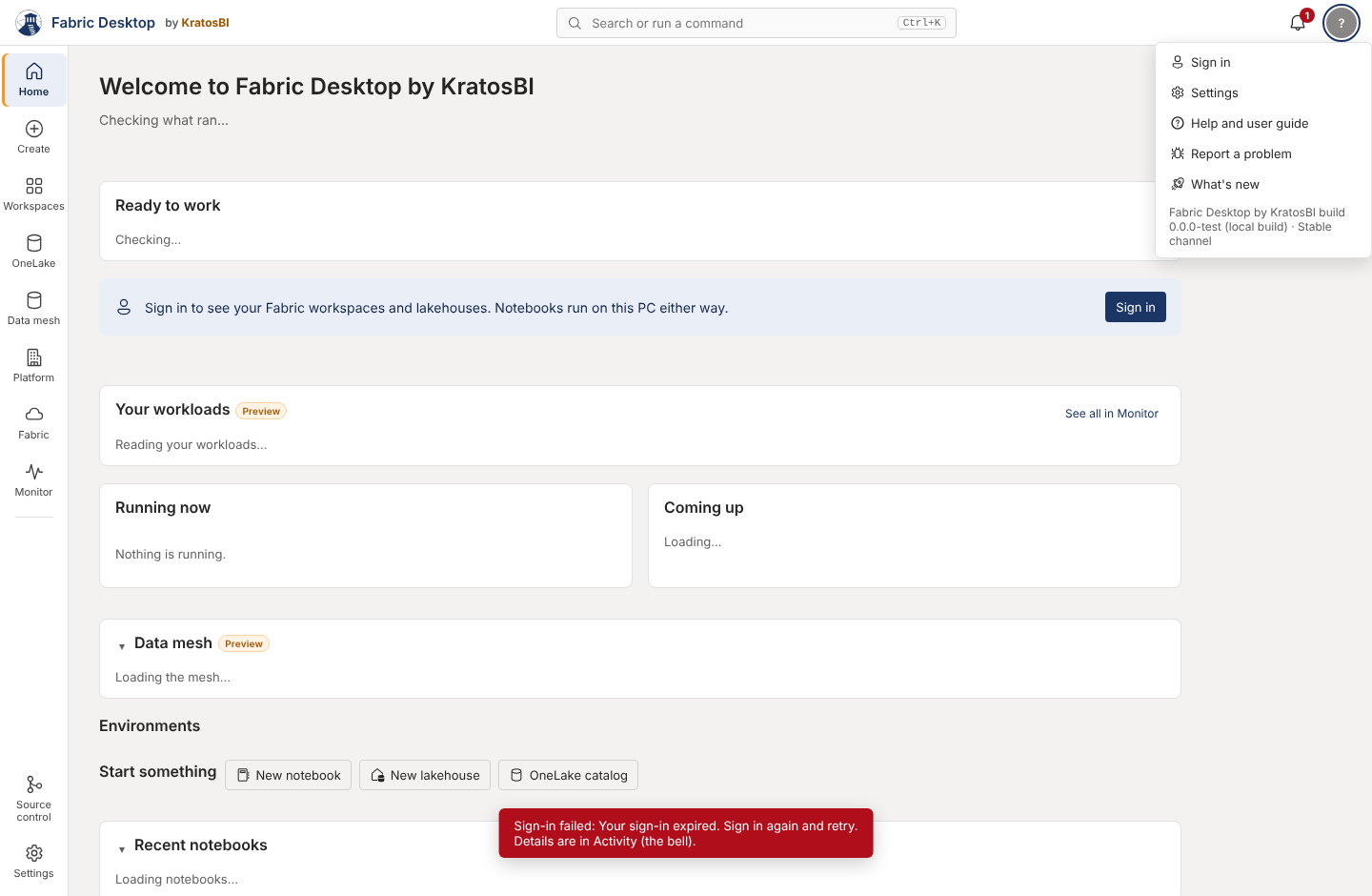
- Now: any AADSTS code not in a short list, including 50076 (MFA required), 50079, 50020 (wrong tenant) and 50058, shows "Your sign-in expired. Sign in again and retry." (images/sign-in-mfa-error.png;
activity.js:51). The message starts "Sign-in failed: Sign-in failed:" (auth.py:149plus the label atapp.js:197). A cancelled prompt is shown as a failure (unverified: exact MSAL cancel payload). - Proposed: the engine returns
{code, description}for sign-in failures; the UI maps the common Entra codes to one sentence each and a next step (complete MFA in the window, use your work account, ask IT about Conditional Access with the code to quote); cancel shows nothing. - Benefit: first-day failures become self-service.
- Scope:
auth.py,friendlyErrorinactivity.js,troubleshooting.mdrows. - Dependencies: enterprise readiness owns sign-in; route there.
- Acceptance: each mapped code shows its sentence; no doubled prefix; cancel leaves no toast.
- Tests: engine unit tests for the structured error;
ui.test.cjscases per code.
UX-004 Screens for local data projects; SQL on this PC (P1)#
- Workflow: W4. The product's core promise.
- Now: the engine works (
docs/local-data.md) but has no UI; the SQL page opens only on a Fabric lakehouse. - Proposed: Create gets a Local data section (projects, Add folder with a picker, tables found); the SQL page gets a "This PC" target; every local screen says "Runs on this PC · no Fabric job" and where behavior differs from Fabric.
- Scope: owned by the local data engine program (FD-LDE), mockup first (Chris's rule).
- Dependencies: FD-LDE local SQL target (in progress); UX-015 folder picker.
- Acceptance: a person with no sign-in can add a folder and query a CSV in four steps.
- Tests: browser test with the real engine (
app/tests/browser).
UX-005 One first-run card on Home (P1)#
- Workflow: W1.
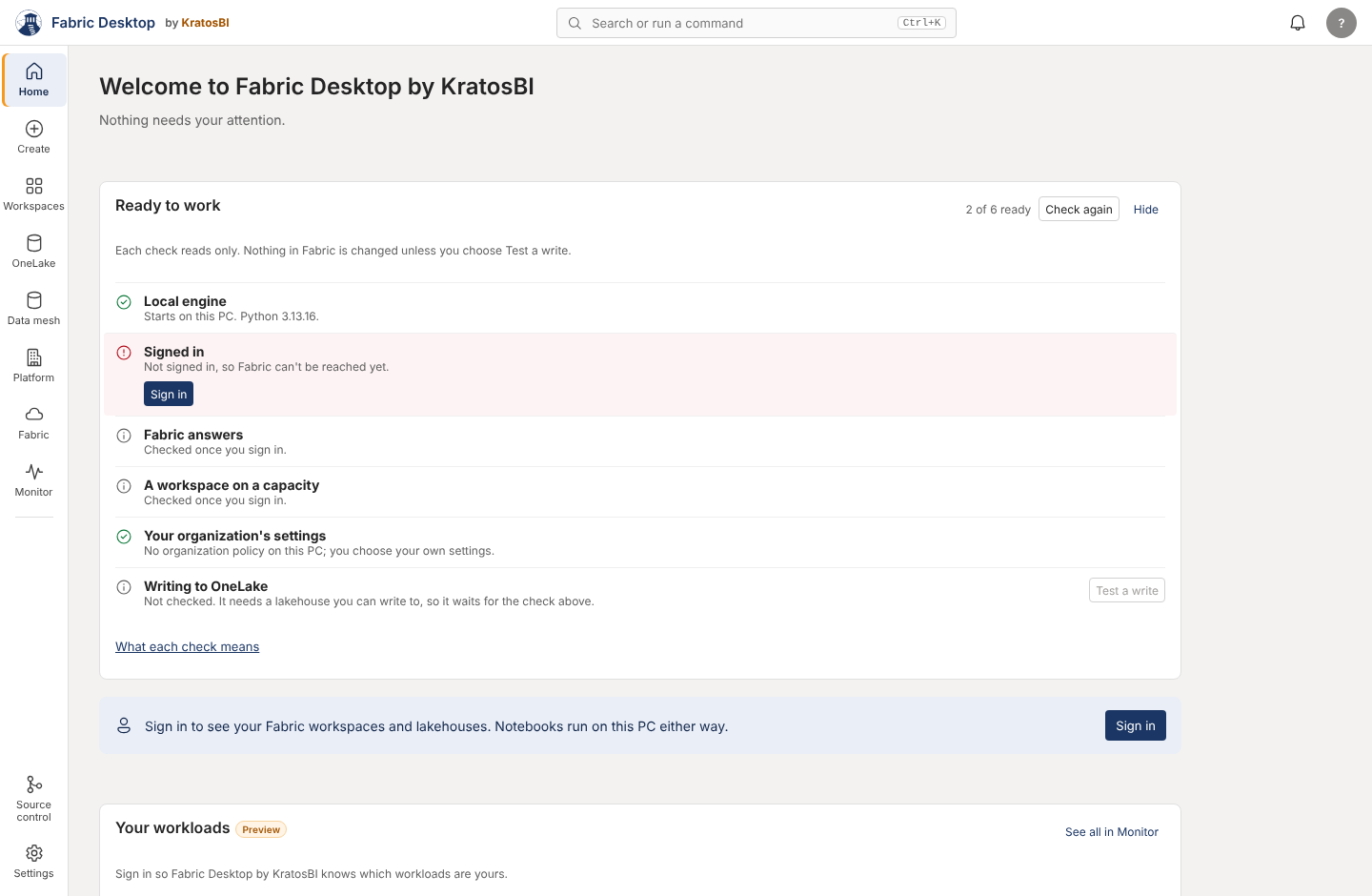
- Now: a new user sees Ready to work (with a Sign in button), a sign-in callout (another Sign in) and, when scrolled, Get started (a third), plus an empty "Environments" heading (images/home-first-run.png;
app.js:353-370,settings.js:477-540). - Proposed: one first-run card with two choices: Sign in to Fabric or Work on this PC (open a notebook or, later, a local folder). Ready to work folds into a one-line status ("Ready · 4 of 6") that expands; Get started shows below once signed in; empty sections are hidden.
- Scope: Home only; mockup first.
- Dependencies: enterprise readiness owns first run; route there.
- Acceptance: at most one Sign in button visible on Home when signed out; nothing reads "Checking…" with no heading content.
- Tests: browser screenshot test signed out and signed in.
UX-006 Advanced settings (P1)#
- Workflow: W1, W2.
- Now: App (client) ID is the second row in Settings > Account for everyone (
settings.js:207-216); saving it does nothing when the environment variable is set, but says "Saved" (app_settings.py:205-208). Five SQL limits, kernel process and cell limits are on the main page. - Proposed: an Advanced section, folded by default, holding App ID, kernel, cell and SQL limits and the SQL temp folder. When policy or the environment sets a value, the field is read-only and says which.
- Scope:
settings.js;app_settings.saverefuses values that the environment overrides. - Acceptance: a default install's Settings shows Account, Updates, Preview features, Usage data, Notifications, Help; Advanced is one click away; no "Saved" for a value that won't apply.
- Tests:
ui.test.cjsfor the fold and the read-only state; engine test for the env override.
UX-007 Help opens the docs for the running build (P1)#
- Now:
open_docalways opensblob/main/docs/...on GitHub (main.rs:958-970). - Proposed: open the published docs site; for Stable, the docs built at the Stable commit (or
blob/<commit>/docs/...until the site keeps versions). - Scope:
main.rsopen_doc, the docs workflow if it keeps a Stable copy. - Dependencies: release management.
- Acceptance: on a Stable build, help shows text from that build's commit.
- Tests: Rust unit test for the URL.
UX-008 Back, forward and reopen where you left off (P1)#
- Now:
go()keeps no history (app.js:224-228); a restart opens Home (app.js:7); "Open in Fabric" has no way back. - Proposed: a history stack of
{view, tab}; Back and Forward in the top bar with Alt+Left and Alt+Right; last view saved and restored on start (Home if it no longer exists); the breadcrumb built from it on every view below the rail. - Scope:
app.jsnavigation; each page's tab state exposed as one field. - Acceptance: Back returns to the previous page and tab, including after Open in Fabric; restart reopens the last page.
- Tests:
ui.test.cjshistory cases.
UX-009 One home for platform-wide things (P1)#
- Now: keys, sources, domains, glossary, data products, requests and platform setup are each in two places, with two "New key table" dialogs writing to different stores (
meta.js:909,platform.js:236). - Proposed: see navigation.md. Platform manages; Data mesh shows read-only views that link to Platform; Settings loses Platform setup.
- Scope: owners agree the split first; mockup.
- Acceptance: each concept has one editing screen; the command bar finds it.
- Tests: browser tests for each moved screen.
UX-010 Monitor: four segments (P1)#
- Now: six segments, eight with open PRs (#145, #163, Run as).
- Proposed: Runs, Schedules, Operations (Workloads, Queue, Agents, Run as, Incidents as views), Cost.
- Dependencies: workload management thread; Chris's open card on Run as.
- Acceptance: Monitor shows four segments; every old command still lands on the right view.
UX-011 One error panel and Retry (P1)#
- Now: raw exception text is the main message in about ten places (
app.js:1303,1379,1600,shortcuts.js:240,245,349,394,deps.js:128,notebook.js:1134); toasts have no Retry, userole=statusand vanish after 8 seconds; 48 silent.catch(() => …)hide failures, including help links that do nothing (settings.js:69,288,290). - Proposed:
errorPanel(err, {retry})(sentence, what to do, Retry, Details expander with Copy);attempt(fn, label, {retry})adds a Retry action to the toast; error toasts userole=alertand pause on hover; data panels show "Couldn't load · Retry". - Scope:
activity.js,app.js; then each call site as owners touch it. - Acceptance: no screen shows a Python exception name as its first line.
- Tests:
ui.test.cjsfor the panel; a check thaterrorPanelis used in the listed sites.
UX-012 Keyboard access (P1)#
- Now: clickable table rows and cards can't be reached by keyboard (11 places);
showMenu(account, Publish options, Git) has no keyboard support and Esc doesn't close it (seen in the running UI); 13 tab implementations, 4 with ARIA, none with arrow keys; the command bar doesn't announce the selected item. - Proposed: shared
clickRow(),menu(),tabs()components with roles, focus and arrow keys;aria-currenton the rail. - Dependencies: enterprise readiness owns accessibility.
- Acceptance: every W1-W10 path can be done with the keyboard alone.
- Tests: browser tests driven by keyboard only.
UX-013 Engine busy (P1)#
- Now: the shell holds one lock for each engine call (
main.rs:299-327); sign-in, publish and runs have no time limit, so everything else waits with no sign why. - Proposed: a top-bar indicator "Working: · Stop" after two seconds; long calls move to start-and-poll.
- Dependencies: codebase audit and hardening (also in the earlier honest review).
UX-014 Never claim all is well when unchecked (P1)#
- Now: Home says "Nothing needs your attention" when run history fails to load (
app.js:411-412); Fabric job tracking stops after one failed poll (activity.js:167-170). - Proposed: "Couldn't read run history · Retry"; poll with backoff and mark items "status unknown" after repeated failures.
UX-015 Pickers instead of typed IDs and paths (P2)#
- Now and proposed: the table in configuration.md.
- Scope: one native folder picker in the shell (shared), then one PR per owner.
UX-016 One environment picker (P2)#
- Now: five independent pickers; the top-bar one shows on two pages.
- Proposed: one
state.env, shown in the top bar on every environment-aware page, labelled "Environment".
UX-017 Plain words (P2)#
- Now:
LH_Keys(17 places),LH_Meta,SQL_Platform, save gate, Type 2 dimension, watermark, V-Order, Unknown member -1, MCP (stdio), object ID; Spark SQL vs DuckDB in one page. - Proposed: say what it does, with the technical name in a tooltip or monospace after it ("the business key table (
LH_Keys)"); a glossary page in docs linked from tooltips.
UX-018 One confirmation for destructive actions (P2)#
- Now: removing a Fabric or PC schedule has no confirmation (
schedules.js:49-51,198-201); overwrites ("Replace the table?", "Overwrite these tables twice?") use a plain confirm with a navy OK. - Also: the engineering quality review (QA-019, PR #176, spec PR-QA-10 to PR-QA-13 in
docs/quality/remediation.md) found 17 destructive actions thatconfirmDialogshows with the destructive choice as the primary button, and 13 different wordings for the same kind of confirmation. - Proposed:
confirmDialog(…, {danger: true, typeToConfirm}): danger styling for every delete and overwrite, with Cancel as the default button; one wording pattern ("Delete name?", what is lost, then the action verb); typed name for overwriting a table or promoting to Prod. - Why: AGENTS.md: protect OneLake data; no operation bypasses confirmation.
UX-019 Help everywhere (P2)#
- Proposed: help links on the 11 screens without one; the Preview list in the docs generated from
PREVIEW_FEATURES(or checked by a test); a Keyboard shortcuts dialog from one table that the handlers also use; troubleshooting rows for each Preview feature as it leaves Preview.
UX-021 Preview tag on Fabric writes (P1)#
- Now: seven actions write to Fabric but have no tenant test and no Preview tag (QA-020, PR #176): Promote, Publish, Create workspace, Sync keys, variable library, quarantine replay, Run all in Fabric.
- Proposed: each gets the Preview tag through
PREVIEW_FEATURESuntil a tenant smoke test covers it; a UI test fails when a Fabric-writing action is neither tenant-tested nor Preview. - Why: AGENTS.md: untested Fabric integrations must keep Preview labeling. Usability gate UG-2 checks it in each release review.
UX-020 Show Home at once (P2)#
- Now: nothing renders until the component and release check returns (
app.js:2619-2622); about 85 plain "Loading…" strings; no shared empty state. - Proposed: render Home with placeholders immediately; run the release check alongside;
loading(label)andemptyState({icon, title, text, action})shared components.
Pull requests#
Each PR is small, tested and independently mergeable. PRs that change visible layout get a mockup first and stay draft until Chris reacts.
| PR | Contains | Mockup first? | Who builds | Risk |
|---|---|---|---|---|
| PR-UX-01 Command bar and help links | UX-001, UX-002 | No | This oversight (shared code) | Low |
| PR-UX-02 Errors you can act on | UX-003, UX-011 (shared part) | No | This oversight for the shared part; sign-in mapping with enterprise readiness | Low |
| PR-UX-03 First run and Settings | UX-005, UX-006 | Yes | This oversight (Settings), enterprise readiness (Home first run) | Medium |
| PR-UX-04 Navigation history and fast start | UX-008, UX-020 | Small (Back/Forward placement) | This oversight | Medium |
| PR-UX-05 Help that matches the build | UX-007, UX-019 | No | Release management (shell), this oversight (docs, links, shortcuts) | Low |
| PR-UX-06 Keyboard components | UX-012 | No | Enterprise readiness, with this oversight | Medium |
| PR-UX-07 One home per concept | UX-009, UX-010, UX-016 | Yes (attached to the audit PR) | Owners | Medium-high |
| PR-UX-08 Pickers | UX-015 | No | Shell folder picker here, then owners | Low each |
| PR-UX-09 Local work in Create | UX-004 | Yes | Local data engine program | Medium |
| PR-UX-10 Honest status | UX-013, UX-014 | No | Hardening; workload management | Medium |
| PR-UX-11 Plain words | UX-017 | No | Owners, with a glossary from this oversight | Low |
| PR-UX-12 Confirmations | UX-018 | No | Shared helper here, call sites by owners | Low |
| PR-UX-13 Preview tags on Fabric writes | UX-021 | No | Each feature owner | Low |
PR-UX-01 spec: Command bar and help links#
- Objective: remove two defects every user meets and stop help links from breaking again.
- Scope:
app/ui/features.js(palettedraw),app/ui/meta.jsandapp/ui/git.js(one anchor each), a test. No layout change. - Existing components:
openPalette,learnMore,XRAY_DOCS, readinessdocfields. - Functional requirements: the palette list contains only group headers and items;
learnMoreanchors andopen_docpages all resolve. - UX requirements: none visible beyond the fix.
- Technical constraints: UI scripts share one global scope; new test helpers stay inside the test file.
- Acceptance: UX-001 and UX-002 acceptance.
- Tests:
node --test app/tests/ui.test.cjspasses, including the new cases. - Docs: none needed beyond this backlog.
- Dependencies: none.
- Definition of done: tests pass in CI; Release Manager UX review PASS.
PR-UX-02 spec: Errors you can act on#
- Objective: every failure says what happened and what to do, with Retry where it makes sense.
- Scope:
activity.js(friendlyErrororder, Entra codes),app.js(attemptwithretry, toast role and hover), newerrorPanel,auth.pystructured sign-in errors. Call sites in other owners' files only where listed in UX-011, each with a note to the owner. - Functional requirements: known patterns are checked engine-first (the hung and stopped engine messages first; local exception names before Fabric HTTP patterns), so
FileNotFoundErroris never called "Fabric couldn't find that item" (activity.js:53,63). - Acceptance: UX-003 and UX-011 acceptance.
- Tests: table-driven
friendlyErrortests for each mapped code and pattern order. - Docs:
troubleshooting.mdrows for each new sign-in message.
PR-UX-03 spec: First run and Settings#
- Objective: a first-time user sees one clear next step; Settings shows what most people change.
- Scope: Home's first-run cards; Settings sections. Mockup first.
- Acceptance: UX-005 and UX-006 acceptance; existing
learnMoreanchors kept (get-started,ready-to-work,settings). - Tests: browser screenshots signed out and signed in;
ui.test.cjsfor Advanced. - Docs: user-guide Get started and Settings sections updated with new screenshots.
PR-UX-04 to PR-UX-12#
Specified by the issues above; each gets a full spec in this format when its owner picks it up, so the spec reflects main at that time.
Need a hand?
Find a fix in troubleshooting, or share a reproducible issue with the community.
Get support ↗Improve this guide on GitHub ↗